
More than 2.28 million candidates sat India’s high-stakes NEET-UG 2026 medical entrance re-examination on Sunday, June 22, in a tightly controlled operation designed to prevent a repeat of the paper leak that forced cancellation of the original test. The re-exam was held at 5,440 centres across India and 14 centres abroad, backed by a security apparatus described by authorities as the largest ever deployed for a single exam.
The National Testing Agency had cancelled the original May 3 examination on May 12 following allegations of a question paper leak. Those allegations were subsequently handed to the Central Bureau of Investigation. The scandal added urgency to an already damaged public trust in the exam, which had also been rocked by similar allegations of leaks, fraud, and grace-mark irregularities in 2024, sparking nationwide protests.
A Fortress Around Every Exam Room
The scale of the security operation was extraordinary. According to the NTA, more than 95,000 exam rooms were fitted with surveillance cameras, with over 1.3 million cameras installed in total across all centres. Live CCTV feeds were monitored simultaneously from the NTA, the Education Ministry, district collectorates, and 34 centrally funded institutions.
The NTA also deployed 51,311 signal jammers, supplied by ECIL and BEL, to block mobile phone networks around exam sites. Drones and dog squads were positioned around some centres, according to India Today. To further shut down potential cheating channels, Telegram was temporarily blocked until Monday over concerns the messaging app could be used to circulate answers.
On the ground, the NTA deployed 38,795 frisking personnel, 48,448 biometric staff for face authentication, approximately 6,700 physical observers, and more than 100 virtual observers. Two invigilators were posted inside every exam room. In total, over 700,000 officials including police, security staff, and exam personnel were involved in running the re-examination, the NTA said.
Strict Checks at the Gates
Candidates faced an unusually rigorous entry process. A strict dress code was enforced, including a ban on enclosed shoes. Security personnel were seen inspecting candidates’ hair and removing earrings at exam centre gates, according to BBC World. Some women were asked to remove nose pins and wrist threads before entering.
The Indian Air Force transported new question papers to certain regions, and experts from academic institutions across the country prepared multiple sets of papers for the retest to reduce the risk of any single set being compromised, according to the NTA. Exam centres were stocked with drinking water, oral rehydration salts, ambulances, shaded waiting areas, extra rough sheets, and wall clocks.
State governments provided free travel for candidates and ensured that facilities at centres were adequate, the NTA said. Special arrangements were made for 81 candidates with medical conditions. Among them was Shrishti Dubey, who had undergone surgery just a week before the exam and sat the test at a West Bengal centre with a separate room and medical support on standby. One candidate was undergoing chemotherapy at the time of the re-examination.
Government Signals Commitment to Fair Testing
Education Minister Dharmendra Pradhan sought to reassure students ahead of the exam. “Sit fearlessly, without worry, and you will definitely do well,” he said, according to BBC World. He also expressed confidence in the institutions overseeing the process, saying he had “complete faith in the NTA, all the state governments, the district administrations, the Indian education system, and India’s students.”
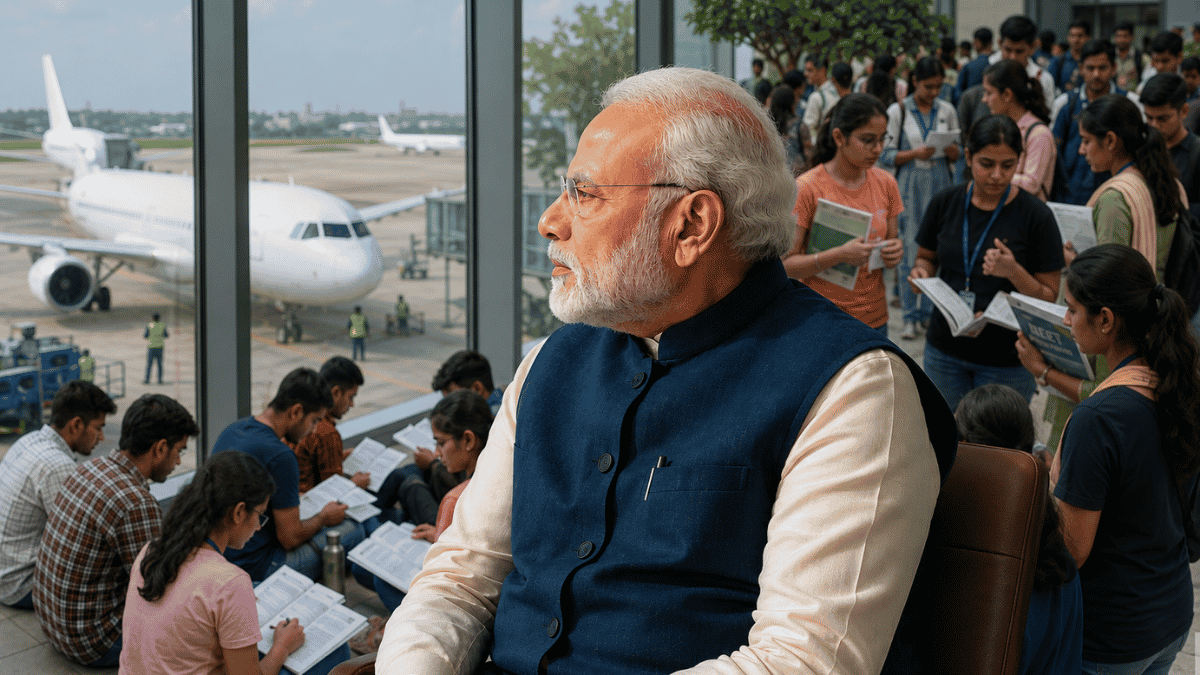
Prime Minister Narendra Modi delayed his departure from Delhi airport on Sunday to avoid disrupting students traveling to exam centres. He arrived at approximately 1:15 pm and waited until after the exam commenced at 2 pm before leaving. Union Minister Sukanta Majumdar described the gesture as a sign of the prime minister’s responsibility and concern for citizens, according to the Indian Express.
Not all candidates were reassured. Diksha, a student speaking to BBC World, captured the mood of many: “There is fear because the paper has leaked once already. This is not a one-off thing.”
The NEET-UG Format and What Comes Next
The NEET-UG is a pen-and-paper test lasting three hours and 15 minutes, comprising 180 questions across physics, chemistry, and biology. It serves as the sole gateway to undergraduate medical admissions across India, making its integrity a matter of national importance.
Separately, the UGC NET June 2026 examination began on the same day, June 22, and is scheduled to run through June 30. Conducted in computer-based test mode across two daily shifts, the UGC NET consists of two papers in a single three-hour session totalling 300 marks with no negative marking. Candidates are required to arrive at least two hours before their scheduled session.